
The number of residential property transactions increased by almost
19% to 44,110 in the 12 months to October 2021, according to the latest
Residential Buildings Report published by GeoDirectory and EY.
It reveals that over 16% of all property transactions were for newly built homes, which was down compared to the previous year.
The average residential property price rose in every county over that period.
The average national house price was €321,596, an increase of 9.4% on the equivalent 2020 figure.
According to the figures, Dublin remained the most expensive location
to buy a house in Ireland, with an average price of €496,652.
Neighbouring counties Wicklow (€428,493) and Kildare (€338,874) were
the only other counties with residential property prices higher than the
national average.
The lowest average house price over the 12 months to October 2021 was recorded in Longford, at €142,298.
Meanwhile, the report reveals that the number of new residential
address points added to the GeoDirectory database last year dropped by
just over 17% compared to the previous year.
Just 18,047 new address points were recorded in Ireland last year.
The data shows that over a quarter of these properties were located in Dublin, a decrease of 26% in the capital.
Almost half of all properties added to the database were located in the greater Dublin area - of Dublin, Meath, Kildare and Wicklow.

According to the report, residential construction activity rallied in
the second half of 2021, following the temporary closure of
construction sites earlier in the year due to Covid-19 restrictions.
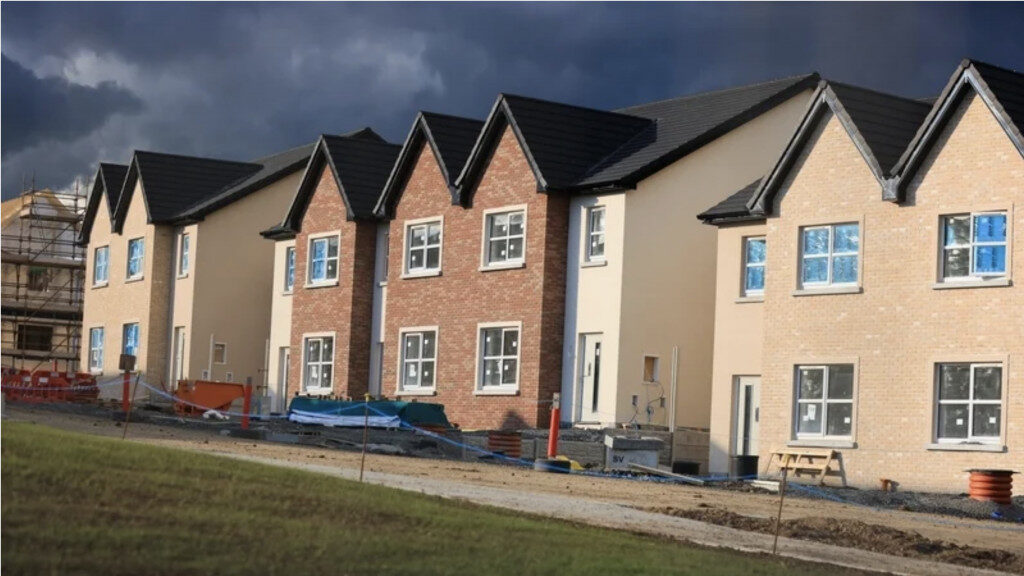
In the fourth quarter of last year,19,495 residential buildings were
under construction, a 16.5% increase on the corresponding figure in
fourth quarter of 2020.
Residential construction activity was strongest in the Leinster
region, accounting for almost 60% of all buildings under construction.
The highest share of the country's residential construction activity
was in Dublin at just over 15%, however this was down slightly on the
same period in 2020.
An increase in residential construction activity was recorded in 18
counties in the final three months of 2021, with the highest
year-on-year increases in Offaly, Waterford and Clare.
The sharpest decreases were in Galway and Leitrim.

"Covid-19 has proved to be a substantial speed-bump for the delivery
of housing supply in Ireland," said Dara Keogh, CEO of GeoDirectory.
"The knock-on impact of the closure of construction sites in early
2021 can be seen in the relatively low number of new address points
added to the GeoDirectory database, which was down 17.4% on the previous
year," he said.
"However, residential construction activity has rebounded strongly
since reopening fully in April, with 19,495 buildings recorded as being
under construction in Q4 2021, the highest figure recorded since we
started this report in 2014. This indicates a strengthening residential
supply pipeline going into 2022," he added.
The report also
reveals that there were 90,158 vacant dwellings recorded in the State
in the final quarter of last year, representing 4.4% of the national
housing stock.
This was a marginal decrease on the same quarter the previous year.
Year-on-year, residential vacancy rates decreased in 20 of the 26 counties.
The lowest residential vacancy rates in the country were found in Dublin, Kildare, Waterford and Louth.
Across the counties of Leinster, the average residential vacancy rate stood at 2.3%.
The three counties with the highest residential vacancy rates were
found in Connacht, which had a province-wide vacancy rate of 9.2%.
Leitrim remained the county with the highest residential vacancy rate at 13.3%, although this was lower than the previous year.
Mayo and Roscommon recorded the next highest vacancy rates.
The report reveals that the number of derelict buildings has dropped
by 7.3% since 2006, with 22,096 derelict residential units across the
country.
The majority of derelict address points last December were located along the west coast of Ireland.
Annette Hughes, Director, EY Economic Advisory said the report
confirms that there is exceptionally high levels of demand in the
housing market.
"This is evident from the significant increase in the average house
price, up 9.4% nationally, with price increases recorded in every
county," she said.
"Based on our analysis for this report, the 90,158 vacant residential properties and the 22,096 derelict residential properties across Ireland should be investigated to ascertain if they can be returned to the housing stock, a move which would also support our retrofitting targets," she added.
Source RTE